AI Test Creation vs Self-Healing Tests: What QA Teams Need to Know
By Antoine Dubois · May 18, 2026
Learn the difference between AI test creation and self-healing test automation, where each fits, and how QA teams can use both to reduce authoring and maintenance work.
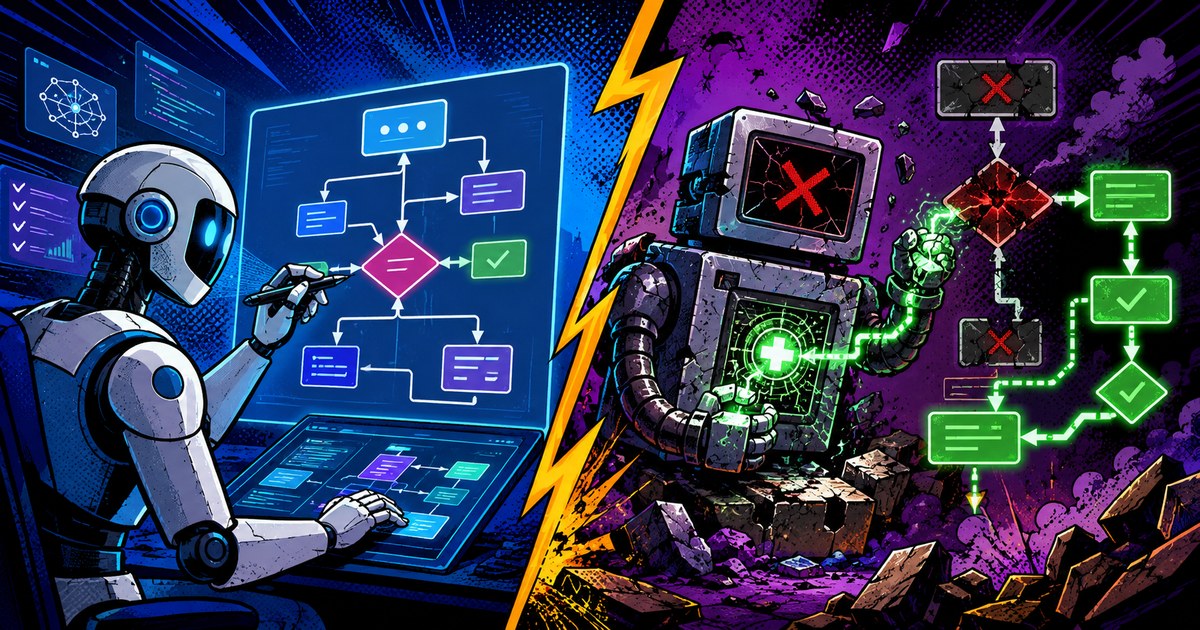
AI test creation and self-healing tests are often discussed as if they solve the same problem. They do not. AI test creation helps teams produce new automated tests faster, usually from plain-English scenarios, recordings, imported scripts, requirements, or application inspection. Self-healing test automation helps existing tests survive UI changes by repairing broken locators or step references during execution.
Both capabilities belong in the broader AI QA toolkit, but they affect different parts of the test lifecycle, require different governance, and fail in different ways.
The short version: creation is about coverage, healing is about maintenance
The simplest way to separate the two is to ask when the AI is doing useful work.
AI test creation works before a test is part of your suite. It helps you go from an idea, requirement, user story, manual test case, or exploratory scenario to an executable automated test.
Self-healing tests work after a test already exists. They help the test continue running when the application changes in ways that would normally break selectors, locators, or element references.
AI test creation answers, “How do we get useful tests written faster?” Self-healing answers, “How do we keep existing tests useful when the UI changes?”
A QA manager usually cares about both outcomes:
- More useful automated coverage, especially for regression paths that are still tested manually
- Lower maintenance cost, especially when UI refactors or component library changes cause noisy failures
- Faster feedback in continuous integration, without turning every failed build into a locator investigation
- Better participation from non-specialists, such as manual testers, product managers, or business analysts
An automation engineer will look at the same capabilities more cautiously:
- Does generated test logic match the real user workflow?
- Are assertions meaningful, or just checking that pages load?
- When a test heals, is it still testing the intended element?
- Are changes auditable, reviewable, and reversible?
- Does the platform keep tests maintainable enough for the team’s long-term strategy?
A platform such as Endtest, an agentic AI, low-code/no-code test automation platform, is a useful example because it supports both sides of the equation. Its AI Test Creation Agent can generate editable Endtest tests from plain-English scenarios, while its self-healing tests can recover from broken locators during execution. That combination matters because test authoring and test maintenance are not separate problems in real teams. New tests immediately become old tests, and old tests need to stay trustworthy.
What is AI test creation?
AI test creation is the use of machine learning, language models, application inspection, or agentic automation to produce executable test cases. The input might be a sentence, a feature description, a manual test case, a browser recording, a design document, or an existing Selenium, Playwright, or Cypress file. The output depends on the tool. It might be source code, platform-native steps, a codeless test flow, test data, or suggested assertions.
In practical terms, AI test creation tries to reduce the blank-page problem in automation.
Instead of an engineer starting with an empty spec file, they might start with a prompt like:
text Test that a user can add a product to the cart, update the quantity to 2, proceed to checkout, and see the correct subtotal before payment.
A code-first tool might turn that into Playwright or Cypress code. A low-code/no-code platform might turn it into editable steps inside its own test editor. Endtest, for example, creates editable platform-native Endtest steps rather than generating raw Playwright, Selenium, JavaScript, Python, or TypeScript source files as its primary output. That distinction is important for teams evaluating maintainability. The generated test should land somewhere your team can inspect, modify, version, schedule, and debug.
For more detail, see the Endtest AI Test Creation Agent documentation.
Common inputs for AI test creation
AI test creation is not limited to prompt-based generation. Mature workflows often use multiple inputs:
| Input type | Example | Strength | Risk |
|---|---|---|---|
| Plain-English scenario | “Log in as an admin and invite a new user” | Fast, accessible to non-coders | Ambiguous unless reviewed |
| Manual test case | Existing test management steps | Preserves current QA knowledge | May automate outdated behavior |
| Browser recording | Tester clicks through workflow | Captures real interactions | Can capture brittle or accidental steps |
| Existing automation | Selenium, Cypress, or Playwright scripts | Accelerates migration | Legacy test smells may be carried forward |
| Requirements or user stories | Acceptance criteria from a ticket | Links tests to product intent | Requirements may lack UI details |
The best AI test creation workflows treat generated tests as drafts, not unquestionable truth. A generated test can save time, but it still needs review for intent, assertions, data setup, and cleanup.
What good AI-generated tests should include
A weak generated test performs clicks and waits without proving anything meaningful. A useful generated test includes:
- A clear starting state, such as a logged-out user, a known fixture, or a seeded account
- Stable element targeting, preferably using roles, labels, test IDs, or platform-managed locators
- Assertions tied to user-visible outcomes, not just implementation details
- Minimal unnecessary waiting
- Reusable test data patterns
- A cleanup strategy if the test creates records
- Human-readable steps or code that the team can inspect
For example, in a code-first Playwright workflow, a generated or hand-written test might prefer accessibility-oriented locators:
import { test, expect } from '@playwright/test';
test('user can add a product to the cart', async ({ page }) => {
  await page.goto('/products');
  await page.getByRole('button', { name: 'Add Backpack to cart' }).click();
  await page.getByRole('link', { name: 'Cart' }).click();
  await expect(page.getByText('Backpack')).toBeVisible();
  await expect(page.getByText('$49.00')).toBeVisible();
});
The point is not that every team should write this exact code. The point is that test creation must produce something understandable. If an AI tool generates selectors like div:nth-child(4) > span > button, the team has not escaped maintenance work. It has merely postponed it.
What are self-healing tests?
Self-healing test automation is the use of AI or heuristic matching to recover when an automated test can no longer find the UI element it expects. In most UI test suites, many failures are locator failures rather than actual product defects. A button still exists, but its generated ID changed. A class name was renamed. A React component wrapper added another level to the DOM. A design system update changed markup while preserving the visible behavior.
A non-healing test usually fails immediately when its selector stops matching:
javascript // Brittle example
await page.click('#checkout_button_1729');
If the application changes the ID to #checkout_button_2041, the test fails even though the user still sees a Checkout button.
A self-healing system tries to infer the intended element from broader context. Depending on the platform, that context may include:
- Previous locator value
- Nearby text
- Element role
- Label text
- Stable attributes
- DOM structure
- Position relative to neighboring elements
- Historical runs
- Visual or semantic similarity
Endtest’s self-healing tests are designed to detect when a locator no longer resolves, evaluate candidate elements, and select a replacement based on surrounding context such as attributes, text, and structure. The Endtest self-healing documentation also emphasizes the importance of recording healed locators, including the original and replacement. That transparency is critical. If a test silently changes what it interacts with, you have created a different kind of flakiness.
Healing is useful only when it is inspectable. A silent heal can be worse than a loud failure if it changes the intent of the test.
What self-healing is not
Self-healing does not mean a broken test is always wrong, and it does not mean a passing healed test is always right.
A self-healing test should not be expected to fix:
- A genuinely removed feature
- A changed business rule
- A workflow that now requires a different user decision
- Missing test data
- Authentication failures
- Backend errors
- Timing problems caused by unstable async behavior
- Assertions that no longer Reflect product requirements
It mainly addresses a narrow but expensive class of failures: locator or element identification breakage caused by UI changes.
That narrower scope is not a weakness. It is why self-healing can be useful. The danger comes when teams overstate it and treat it as a substitute for test design, product knowledge, or triage discipline.
AI test creation vs self-healing tests: side-by-side comparison
| Dimension | AI test creation | Self-healing tests |
|---|---|---|
| Primary goal | Create new automated tests faster | Keep existing tests running after UI changes |
| Lifecycle stage | Authoring and expansion | Execution and maintenance |
| Typical input | Prompt, user story, manual test, recording, existing script | Existing test with a broken locator |
| Typical output | New test steps, code, or platform-native flow | Updated locator or recovered step |
| Main user | QA analyst, SDET, automation engineer, product-adjacent tester | Automation engineer, QA manager, CI owner |
| Biggest benefit | Faster coverage creation | Fewer false failures and lower maintenance |
| Biggest risk | Shallow or incorrect tests | Masking real UI or intent changes |
| Review need | Test logic and assertions | Healed locator and execution evidence |
| Best metric | Useful automated coverage added | Maintenance time and false locator failures reduced |
The comparison becomes clearer if you think in terms of questions.
AI test creation asks: “What should we test, and how can we turn that into an executable automated flow?”
Self-healing asks: “This existing test used to find an element. Has the element changed in a way we can safely recover from?”
Those are different forms of assistance. A strong AI QA strategy uses each one where it fits.
Example workflow: using both capabilities together
Suppose your team owns a subscription billing page. A new workflow allows an account admin to upgrade from the Basic plan to the Pro plan. You want regression coverage before release, but your automation backlog is already full.
With AI test creation, the team might describe the behavior:
As an account admin, log in, open Billing, upgrade from Basic to Pro, confirm the upgrade, and verify that the Billing page shows the Pro plan.
In Endtest, the AI Test Creation Agent can use a plain-English scenario to generate a working end-to-end test with editable platform-native steps and assertions inside the Endtest editor. The team can then inspect the generated flow, adjust variables, improve assertions, and add it to the suite. This is especially useful when the people who understand the workflow are not the same people who maintain a code-based automation framework.
A reviewer might refine the generated test by checking:
- Does it use a test account that is safe to modify?
- Does it avoid charging a real payment method?
- Does it verify the plan change in the UI and, if needed, in an admin-facing confirmation?
- Does it reset the account after the run or use an isolated fixture?
- Does it handle confirmation dialogs and asynchronous status updates reliably?
Three weeks later, a frontend developer refactors the Billing page. The “Upgrade to Pro” button still appears to users, but the DOM structure changes. In a brittle suite, the test fails because the locator no longer matches. With self-healing enabled, the platform may identify the same button using its visible text, role, surrounding section, or related attributes, then continue the run and record the replacement locator for review.
This is where the two capabilities reinforce each other:
- AI creation reduced the cost of adding the test
- Self-healing reduced the cost of keeping it alive
- Human review kept both steps aligned with product intent
The last point is the one teams should not skip. AI assistance is most valuable when it reduces mechanical work, not when it removes accountability.
Where AI test creation helps most
AI test creation is particularly useful when your team has coverage gaps but limited automation capacity.
1. Converting manual regression suites
Many QA teams have years of manual regression cases in a test management tool. Some are valuable. Some are outdated. Some are too vague to automate directly. AI test creation can help convert the better ones into automated tests, but the conversion should be selective.
Good candidates include:
- Stable workflows repeated every release
- High-value smoke tests
- Permission and role-based flows
- Checkout, signup, onboarding, and account management paths
- Regression tests with clear expected results
Poor candidates include:
- One-off exploratory notes
- Tests dependent on subjective visual judgment
- Tests requiring complex external systems without mocks or test environments
- Steps that rely on tribal knowledge not written in the case
A useful pattern is to run a manual test case audit before automation. Remove duplicates, clarify expected results, and mark which cases are worth automating. AI can accelerate conversion, but it should not automate clutter.
2. Enabling non-programmers to author tests
Low-code/no-code AI test creation is valuable when domain experts understand the product better than they understand JavaScript, Python, or Java. A billing specialist, QA analyst, or product manager may be able to describe an important workflow precisely, even if they cannot implement a framework-level test.
This does not eliminate the need for automation engineers. It changes their role. Instead of writing every click from scratch, they define patterns, review generated tests, manage data, enforce naming conventions, and keep the suite healthy.
Endtest’s no-code testing capabilities are relevant here because generated tests remain editable in the platform rather than becoming source files that only framework specialists can maintain.
3. Speeding up migration from older frameworks
Some tools can import or transform existing tests. Endtest, for instance, provides guidance for teams migrating from Selenium. This can be useful when a team wants cloud execution, a shared low-code/no-code authoring surface, or self-healing without maintaining as much framework plumbing.
Migration still requires judgment. If the source suite is full of sleeps, brittle CSS selectors, duplicated flows, and weak assertions, conversion alone will not make it good. Treat migration as a chance to improve test design.
Where self-healing tests help most
Self-healing is most useful in UI-heavy applications where markup changes more often than user behavior.
1. Design system and component refactors
Teams that use component libraries often refactor markup while preserving user-facing behavior. A button might move from one wrapper component to another. Classes might change after a design token update. Generated IDs might differ between builds.
Self-healing can reduce the noise from these changes, especially for tests that target stable user interactions. Instead of failing because a class changed from .btn-primary to .button-primary, the test can continue if it can confidently identify the same “Save changes” control.
2. Large regression suites with recurring locator churn
Once a UI suite grows beyond a small smoke pack, maintenance becomes a major cost. Even well-designed tests need updates. Self-healing can act as a buffer between routine UI churn and CI failures, allowing engineers to review locator changes in batches rather than interrupting every build.
3. Imported or recorded tests that need extra resilience
Recorded tests often produce locators that work initially but are not ideal long term. Imported legacy tests may have the same problem. Self-healing can help stabilize these tests while the team gradually improves naming, data setup, and assertions.
This is one reason Endtest’s position is interesting. Its self-healing applies across recorded tests, AI-generated tests, and imported tests, according to its product description. For teams mixing creation methods, a common healing layer is more practical than having resilience apply only to one authoring style.
Failure modes and edge cases
The hardest part of comparing AI test creation vs self-healing tests is not explaining what they do. It is understanding how they fail.
AI test creation can produce plausible but weak tests
Generated tests can look correct while missing the business-critical assertion. For example, a test for password reset might verify that a “Check your email” message appears, but not that the reset link works, expires correctly, or cannot be reused.
A generated checkout test might click through the flow but avoid asserting tax, shipping, discounts, or final order status. It may be useful as a smoke test, but not enough as financial regression coverage.
Review generated tests with questions such as:
- What bug would this test catch?
- What important bug would it miss?
- Is the assertion tied to business value?
- Does it rely on test data that will drift?
- Is the test deterministic enough for CI?
Self-healing can heal to the wrong element
Consider a page with two similar buttons:
<section aria-label="Basic plan">
  <button>Upgrade</button>
</section>
<section aria-label="Pro plan">
  <button>Upgrade</button>
</section>
If the original locator breaks, a healing system must distinguish between two visually similar candidates. Context matters. The correct choice might depend on section labels, pricing text, element order, or previous interaction history.
This is why transparent healing logs are important. A reviewer should be able to see what changed and decide whether the healed locator should be accepted, edited, or rejected.
Healing should not hide product changes
Suppose a product team changes “Delete workspace” to “Archive workspace” because the behavior changed from permanent deletion to reversible archiving. A self-healing system might still find a button in the same area of the page, but the test intent has changed. Passing the test may be misleading.
Good governance should require human review for healed locators, especially on high-risk flows such as billing, permissions, data deletion, and compliance-related workflows.
AI-generated tests can amplify environment problems
If your test environment lacks stable seeded data, generated tests may create duplicates, depend on stale accounts, or fail unpredictably. AI test creation does not remove the need for test environment engineering.
For example, a team may still need a setup API to create known state:
typescript
async function createTestUser(request, role: string) {
  const response = await request.post('/test-support/users', {
    data: { role }
  });
if (!response.ok()) {
throw new Error(Could not create ${role} test user);
}
return response.json(); }
Whether your tests are generated, recorded, or hand-written, deterministic setup is one of the strongest predictors of stable automation.
How to evaluate AI test creation tools
When comparing AI test creation tools, avoid focusing only on the prompt demo. A polished demo can generate a simple login test. Real value appears when the workflow is messy.
Ask these questions:
- What does the tool generate, source code or platform-native steps?
- Can generated tests be edited without regenerating everything?
- Are assertions generated, or only actions?
- How does the tool choose locators?
- Can it use existing manual tests or automation files?
- How does it handle authentication, test data, and environment variables?
- Can non-programmers understand the generated result?
- Can engineers review changes in a controlled way?
- Does it integrate with CI/CD and reporting?
- What happens when the app changes after the test is created?
Endtest’s AI Test Creation Agent is favorable for teams that want a shared authoring surface and do not want every contributor to learn browser driver setup or framework internals. The generated tests become editable Endtest steps, which keeps the workflow accessible while still allowing review and refinement. That is different from a code generator that produces a test file and leaves the team to maintain framework dependencies, runners, drivers, and infrastructure.
That said, code-first teams may prefer generated Playwright or Cypress code if they already have strong engineering ownership, custom fixtures, and review practices. The right choice depends on who authors tests, who maintains them, and where the organization wants complexity to live.
How to evaluate self-healing test automation
Self-healing should be evaluated with controlled UI changes, not only with vendor examples.
Create a small test page or staging branch and make changes such as:
- Rename an ID
- Change a CSS class
- Move a button into a wrapper element
- Add a second similar button nearby
- Change button text slightly
- Remove the intended element completely
- Replace a link with a button that has the same label
Then observe what the tool does. A good self-healing system should recover from harmless locator changes, avoid unsafe healing when confidence is low, and record what happened.
A simple experiment matrix might look like this:
| Change | Expected behavior |
|---|---|
| ID changes, label stays the same | Heal successfully |
| Class changes, role and text stay the same | Heal successfully |
| Element moves within same section | Heal if context is clear |
| Two matching buttons exist | Heal cautiously or require review |
| Feature removed | Fail clearly, do not invent a match |
| Text changes from Delete to Archive | Prefer review, because intent may have changed |
For Endtest specifically, the self-healing tests documentation emphasizes automatic recovery from broken locators when the UI changes, with the goal of reducing maintenance and flaky test failures. The practical value is strongest when combined with transparent logs and a review habit. Healing is not magic, and a credible platform should not pretend it is.
Accessibility, locators, and AI test reliability
Accessible markup often makes automated tests more reliable. When elements have meaningful roles, labels, and names, both code-first frameworks and platform-native tools have better signals to target the right control.
For example:
<button data-testid="confirm-upgrade" aria-label="Confirm upgrade to Pro">
  Confirm upgrade
</button>
Good markup improves accessibility, testability, and healing confidence. AI is more effective when the application exposes meaningful signals.
Teams should also keep accessibility requirements separate from ordinary functional checks. If your product needs accessibility validation, align with WCAG and consider dedicated tooling. Endtest provides accessibility testing capabilities and related accessibility testing documentation.
Metrics that separate value from hype
To understand whether AI test creation or self-healing is helping, measure outcomes tied to team behavior rather than vanity counts.
For AI test creation, useful metrics include:
- Number of reviewed and accepted tests added to the regression suite
- Percentage of generated tests modified before acceptance
- Time from scenario identification to first executable test
- Coverage of critical user journeys
- Defects caught by newly generated tests
- Reduction in manual regression effort for stable workflows
For self-healing tests, useful metrics include:
- Number of locator failures avoided or automatically recovered
- Number of healed locators accepted after review
- Number of incorrect heals found during review
- Reduction in CI failures caused by locator churn
- Maintenance time spent per release
- Flake rate by suite, feature area, or application surface
Avoid simplistic metrics such as “AI generated 500 tests.” Five hundred shallow tests can slow down delivery. A smaller number of reviewed, deterministic, assertion-rich tests is usually more valuable.
Governance: how to use both without losing trust
Trust is the central issue in AI QA. If engineers do not trust the generated tests or healed locators, they will bypass the system. If managers trust them too much, the team may miss defects.
Use AI to reduce mechanical effort, not to outsource test intent.
A balanced governance model can be lightweight.
Review generated tests before adding them to critical suites
Treat AI-created tests like code or configuration changes. Someone should inspect the steps, assertions, test data, and naming before the test becomes part of a blocking CI gate.
Separate smoke, regression, and high-risk flows
Not every test needs the same review standard. A low-risk smoke test for page availability can be reviewed quickly. A billing, permissions, or data deletion test deserves more scrutiny.
Review healed locators regularly
Self-healing logs should not become ignored noise. Assign ownership for reviewing healed changes, especially when they affect critical flows. The review can be daily for active projects or per release for slower-moving products.
Keep stable locator practices
Self-healing should complement good locator strategy, not replace it. Developers should still add accessible labels, stable roles, and test-friendly attributes where appropriate.
Which should you prioritize first?
The right priority depends on your current pain.
Choose AI test creation first if:
- Your manual regression backlog is large
- Your team has limited automation engineers
- Product experts can describe scenarios but cannot code tests
- You are starting a new suite and need fast coverage
- You want to standardize authoring in a low-code/no-code platform
Choose self-healing first if:
- You already have a meaningful UI test suite
- CI is noisy because locators break often
- Frontend refactors are frequent
- Automation engineers spend too much time fixing selectors
- Recorded or legacy tests need stabilization
Choose both if:
- You are expanding coverage and want to keep maintenance under control
- Multiple roles contribute tests
- Your UI changes frequently but user workflows remain stable
- You want one platform to support authoring, execution, maintenance, and review
This is where Endtest is a strong example for QA managers comparing platform approaches. As an agentic AI, low-code/no-code test automation platform, it combines AI test creation and self-healing in the same environment. That reduces the handoff between “create the test” and “keep the test working.” A generated test is not thrown over the wall into a separate maintenance tool. It becomes part of the same executable suite that can benefit from healing during runs.
Practical rollout plan for QA teams
A sensible rollout does not start by turning AI loose on the entire test portfolio. Start with a focused workflow.
Phase 1: Pick a stable, valuable user journey
Choose something important but not chaotic. Good examples include login, invite user, update profile, create project, add item to cart, or export report. Avoid brand-new features still changing daily.
Phase 2: Generate or create the first test
Use AI test creation to produce a first version. Review it as a team. Improve assertions, remove unnecessary steps, and clarify data setup.
Phase 3: Run it repeatedly in CI or scheduled execution
A test only proves its value over repeated runs. Watch for timing issues, data drift, and environment failures.
Phase 4: Introduce controlled UI changes
Change a locator, class, wrapper, or nearby element in a staging branch. Observe whether self-healing recovers correctly and whether the healing record is understandable.
Phase 5: Define acceptance rules
Decide when a generated test can join the main suite and when a healed locator can be accepted permanently. Write down simple rules so the team does not debate every case from scratch.
Example policy:
ai_test_policy:
  generated_tests:
    require_review: true
    minimum_assertions: 1
    critical_flows_require_owner_approval: true
  self_healing:
    allow_run_continuation: true
    require_review_for_critical_flows: true
    reject_heal_when_intent_changes: true
The policy does not need to be elaborate. It just needs to make expectations explicit.
Final verdict: different tools for different automation costs
AI test creation and self-healing tests solve two different automation costs. AI test creation reduces the cost of producing tests. Self-healing reduces the cost of maintaining them when the UI changes. Treating them as competitors misses the point. In a healthy AI QA strategy, they are complementary.
For QA managers, the comparison should focus on lifecycle economics: how quickly can the team create meaningful coverage, and how much effort is required to keep that coverage trustworthy? For automation engineers, the comparison should focus on inspectability, deterministic execution, locator quality, review workflows, and failure behavior.
Endtest is a credible example of the combined approach because its AI Test Creation Agent creates editable platform-native tests, and its self-healing capability can recover from locator changes across different test authoring sources. That does not remove the need for thoughtful test design, but it does reduce two of the most persistent sources of UI automation friction: getting tests written and keeping them alive.
The practical takeaway is simple: use AI to accelerate the mechanical parts of test automation, but keep humans responsible for intent. Let AI help create the first draft. Let self-healing handle routine locator churn. Then make review, assertions, data setup, and risk-based prioritization the parts your team refuses to automate blindly.